| What it treats | Urine symptoms from benign prostatic hyperplasia (BPH) |
|---|---|
| Anaesthesia | Local anaesthesia; mild sedation if needed |
| Entry point | Needle puncture in the wrist or groin |
| Time taken | Usually 1–3 hours |
| Hospital stay | Usually same day or 1 night |
| Back to routine | Usually a few days |
Prostate artery embolisation is also spelled “prostate artery embolization” (US spelling). It is a treatment for an enlarged prostate (BPH), the non-cancer growth of the prostate that is common as men get older (NIDDK). It is not a treatment for prostate cancer.
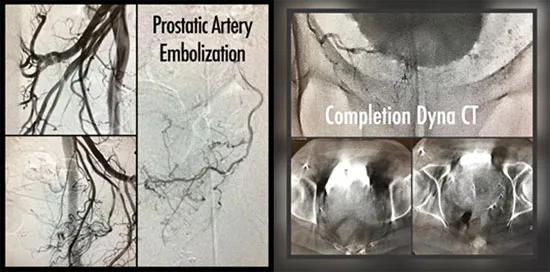
What is PAE, in plain words?
PAE reduces the blood supply to the prostate so that the gland softens and shrinks, which takes pressure off the urine tube. The prostate is a small gland below the bladder. The urine tube (urethra) runs through its middle. When the prostate grows, it squeezes that tube, so urine flows slowly, you go often, and you wake up at night to pass urine.
In PAE, a doctor guides a very thin tube (a catheter) through the arteries to the small arteries that feed the prostate. Tiny particles called microspheres are then released. They block those arteries. With less blood, the prostate tissue slowly shrinks and softens over the following weeks.
PAE is done by an interventional radiologist. This is a doctor who treats problems from inside the blood vessels through a needle puncture, using X-ray images to guide the way, instead of through a surgical cut. Dr. Sheorain (MD Radiology, FSIR) is an interventional radiologist. For how the same method is used in other parts of the body, see what is embolisation?
Where PAE fits among enlarged prostate treatments
PAE is one step on a ladder of enlarged prostate treatments, usually considered after tablets and as an alternative to surgery, not as the first thing to try. Many men are treated by a urologist, and PAE is often decided together with the patient’s urologist.
| Option | What it involves | Anaesthesia | Hospital stay | Who it usually suits |
|---|---|---|---|---|
| Watchful waiting | Regular check-ups, fewer drinks in the evening, less tea and coffee | None | None | Mild symptoms that do not bother you much |
| Tablets | Alpha blockers relax the prostate muscle; 5-alpha reductase inhibitors shrink the gland slowly | None | None | Mild to moderate symptoms; usually the first treatment |
| Prostate artery embolisation (PAE) | Needle puncture in the wrist or groin; arteries to the prostate blocked from inside | Usually local anaesthesia, with light sedation if needed | Usually same day | Men whose symptoms continue on tablets, who have side effects from tablets, or who want to avoid surgery or cannot have it |
| Other minimally invasive options (for example steam therapy or prostate lift implants) | Done through the urine tube by a urologist | Varies | Varies | Selected men, depending on prostate size and shape |
| TURP or laser prostate surgery | Prostate tissue removed through the urine tube by a urologist | Spinal or general anaesthesia | Usually 1 to 3 days (NHS) | Men who need the most direct relief, or whose prostate shape suits surgery |
Source for options: NIDDK, Prostate Enlargement (BPH)., NHS, TURP.
Are you a good candidate? (checklist)
Whether PAE suits you depends on your symptoms, your prostate size and your tests, and some men are better served by tablets or surgery. Prostate cancer must always be ruled out before PAE.
| Likely suitable | Not suitable | Tests needed first |
|---|---|---|
| Urinary symptoms that continue despite tablets | Prostate cancer suspected and not yet ruled out | PSA blood test |
| Side effects from tablets you cannot accept | Severely narrowed or twisted pelvic arteries that a catheter cannot pass | Ultrasound of the prostate and bladder |
| You want to avoid surgery or general anaesthesia | Certain bladder problems where the bladder muscle, not the prostate, is the main cause | Urine flow test and leftover urine check |
| You are not fit for surgery because of other health problems | Poor kidney function or a serious allergy to contrast dye | CT angiography to map the prostate arteries |
| Kidney function test |
If you are not sure where you fit, bring your reports to the OPD. Dr. Sheorain will tell you plainly if PAE is not the right choice, and when your urologist’s advice should come first.
How PAE is done, step by step
PAE is done through a needle puncture under X-ray guidance, usually with local anaesthesia, and most men are awake and comfortable during it. Here is what usually happens:
- Preparation. Your test reports, including the CT angiography, are checked. You are asked not to eat for a few hours before.
- Numbing. The skin over an artery in the wrist or the groin is numbed with local anaesthesia. Light sedation is given if you need it.
- Needle puncture and catheter. A small needle puncture lets a thin tube enter the artery. There is no cut.
- Finding the prostate arteries. Using X-ray and contrast dye, the doctor guides the tube to the small arteries on each side of the prostate.
- Blocking the arteries. Microspheres are released into these arteries, usually on both sides.
- Finishing. The tube is removed and the puncture is closed with pressure or a small device.
The procedure usually takes 1 to 3 hours, depending on the arteries. A urine catheter is not usually needed afterwards. Most men go home the same day (SIR).
Recovery: the first days and weeks
Most men have some pelvic discomfort and urinary changes for a few days after PAE, and the urinary symptoms then improve slowly as the prostate shrinks. This is called post-embolisation syndrome, and it is expected.
What you may feel in the first days:
- Discomfort or an ache in the lower belly or behind the scrotum
- Passing urine more often, or a burning feeling when you pass it
- A mild fever or tiredness
- Small amounts of blood in the urine or semen
These usually settle on their own or with tablets your doctor gives you, usually within a week or two. Light daily activity is usually fine soon after, and heavy work can wait for a short time as advised.
Improvement in urine flow is gradual. Most men notice it over several weeks to a few months, as the gland shrinks (NICE IPG611). Follow-up visits check your symptoms, and sometimes a repeat ultrasound or flow test is done.
PAE vs TURP vs tablets
PAE, TURP and tablets each suit different men; none is right for everyone, and the choice depends on your prostate, your symptoms and what matters most to you. TURP (transurethral resection of the prostate) is a well-established operation done by a urologist. It has the longest track record of the three.
| PAE | TURP | Tablets | |
|---|---|---|---|
| Anaesthesia | Usually local, with light sedation | Spinal or general | None |
| Cut or puncture | Needle puncture in wrist or groin | No skin cut; done through the urine tube | None |
| Urine catheter afterwards | Not usually | Usually, for a few days | No |
| Hospital stay | Usually same day | Usually 1 to 3 days | None |
| Effect on ejaculation and sex | Ejaculation changes are less common than after TURP | Ejaculation changes are common after TURP | Some tablets can affect ejaculation or sex drive |
| Time to benefit | Weeks, as the gland shrinks | Usually soon after recovery | Days for alpha blockers; months for 5-alpha reductase inhibitors |
| Who it suits | Men who want to avoid surgery or cannot have it, or want to protect sexual function | Men who need direct, lasting relief and are fit for surgery | Mild to moderate symptoms; first step for most men |
Sources: NIH PMC9865478, NIDDK., NICE IPG611, NHS, TURP, SIR.
Risks and side effects
Like any procedure, PAE has risks, and most of them are mild and short-lived. Possible side effects include:
- Pelvic or rectal discomfort for a few days
- Burning when passing urine, or passing urine more often
- A urinary infection
- Blood in the urine, semen or stool for a short time
- Bruising at the puncture site
- Rarely, the particles reach an artery they were not meant for, such as one to the bladder or rectum (non-target embolisation)
- Sometimes, symptoms do not improve enough, and another treatment is needed
How long do the results last?
PAE can give relief for a long time in many men, but the prostate can keep growing, so some men later need a repeat PAE or another treatment. (NICE IPG611) Keeping your follow-up visits helps catch any return of symptoms early.
When to see a doctor urgently
Emergency: If you cannot pass urine at all, have blood clots in your urine, or have a fever with chills along with urinary symptoms, go to the nearest emergency department now. Not being able to pass urine (acute urinary retention) needs a catheter straight away.
Your first OPD visit
Your first visit is to find out whether PAE suits you, and you will leave knowing your options even if PAE is not the answer.
- Bring: your PSA report, prostate and bladder ultrasound, urine flow test if done, and the list of tablets you take.
- Talk: Dr. Sheorain asks about your symptoms, how they affect sleep and daily life, and any other health problems.
- Review: he checks your reports and orders any missing tests, such as a CT angiography.
- Plan: he explains whether PAE, tablets or surgery suits you, often in discussion with your urologist.
Medanta Vascular OPD: Floor 5, Vascular OPD, Medicity, Islampur Colony, Sector 38, Gurugram, Haryana 122001. Monday to Saturday, 9:00 AM to 5:30 PM. See how to reach the Vascular OPD, Dr. Virender Sheorain’s training and credentials, and other men’s health conditions, including varicocele treatment without surgery.
Videos: prostate artery embolization


Common questions about prostate artery embolization
Is an enlarged prostate (BPH) a serious problem?
BPH is not cancer and does not turn into cancer, but it can seriously affect daily life and sometimes cause blocked urine, infections or bladder problems. That is why worsening symptoms should be checked, not ignored (NIDDK).
What is grade 1 prostatomegaly?
It means the prostate is mildly enlarged on ultrasound. Many men with grade 1 enlargement need only monitoring or tablets. The decision depends on your symptoms, not the grade alone.
Is PAE better than TURP?
Neither is better for everyone. TURP is a well-established surgery. PAE avoids surgery and general anaesthesia and suits some men better, for example those who want to protect sexual function or cannot have surgery. Your prostate size, symptoms and test results decide which fits.
Does PAE affect sexual function?
PAE does not involve cutting or removing prostate tissue through the urine tube, so it is generally thought to have less effect on ejaculation than TURP (SIR). A small amount of blood in the semen can appear for a short time after the procedure. Discuss any concern about sexual function with Dr. Sheorain before treatment.
Who should not have PAE?
PAE is not suitable if prostate cancer has not been ruled out, or if the pelvic arteries are too narrow or twisted for the catheter to reach the prostate. It may also not help when the main problem is a weak bladder rather than the prostate. Tests at the first visit help decide.
How long does recovery take after PAE?
Most men go home soon after the procedure and return to light daily activity within days. Discomfort and urinary burning usually settle within the first week or so. Urine flow improves gradually over the following weeks as the prostate shrinks.
Sources
This page follows these patient resources and guidelines:
- Transurethral resection of the prostate (TURP) (NHS)
- Prostate artery embolisation for benign prostatic hyperplasia (IPG611) (NICE guidance, UK)
- Enlarged prostate (BPH): diagnosis and treatment (RadiologyInfo, RSNA & ACR)
- Enlarged prostate (benign prostatic hyperplasia) (NIDDK, US National Institutes of Health)
Related
Enlarged Prostate (BPH)
A growing prostate that causes urine problems.
Learn more →What is Embolization?
How blocking a blood vessel from inside treats many problems.
Learn more →Uterine Artery Embolization
Shrinks fibroids by cutting off their blood supply. The womb is kept.
Learn more →
Who performs this procedure
Dr. Virender Sheorain, Director, Peripheral Vascular & Endovascular Sciences, Medanta – The Medicity, Gurugram. Trained at AIIMS New Delhi and in three fellowships in the USA.
Read Dr. Sheorain's profile →This is general information. Please consult the doctor for advice about your condition.