A varicocele is a group of swollen veins above the testicle, inside the scrotum, caused by weak valves that let blood pool instead of flowing back to the heart. It is the same kind of valve problem that causes varicose veins in the legs, just in a different place. Most varicoceles are on the left side, because of the way the left testicular vein drains into the kidney vein (Urology Care Foundation).
This page helps you decide three things: whether you need treatment at all, which options fit your grade, and how the non-surgical option compares with surgery.
Do you need treatment at all?
Many varicoceles need no treatment, and a doctor may simply check yours from time to time. A varicocele is common, and many men live with one without pain, fertility trouble or any change in the testicle (Urology Care Foundation).
Treatment is usually considered for one of three reasons:
- Ongoing pain or heaviness. A dull ache or dragging feeling in the scrotum that gets worse after standing, exercise or a long day, and affects work or sleep.
- Fertility or semen problems. You and your partner are trying for a child, and a semen analysis shows a low count or poor sperm quality. The ASRM patient site ReproductiveFacts explains that a varicocele can affect sperm, but not every man with one is infertile.
- A shrinking testicle. The testicle on the side of the varicocele is getting smaller, which matters most in teenagers and young men.
Watching is usually fine when there is no pain, the testicle is a normal size, and fertility is not a concern or the semen report is normal. In that case, the plan is a check-up at intervals. You can always come back if something changes.
Your options by grade (grade 1, 2 and 3)
The grade tells you how large the varicocele is, but the decision to treat depends on your symptoms, fertility and testicle size, not on the grade alone. Doctors grade a varicocele during a physical examination, usually with you standing up.
| Grade | How it feels or looks | Typical options |
|---|---|---|
| Subclinical | Cannot be felt. Seen only on a scrotal Doppler ultrasound | Usually no treatment (ReproductiveFacts) |
| Grade 1 | Small. Felt only when you bear down, as if straining, while standing | Watch if there are no problems. Embolisation or surgery if there is pain, a fertility problem or a shrinking testicle |
| Grade 2 | Medium. Felt while standing, without straining, but not seen | Same as grade 1: watch, or treat if there is pain, a fertility problem or a shrinking testicle |
| Grade 3 | Large. Seen through the skin, often described as a “bag of worms” | Same rule. Larger varicoceles are more often the ones causing symptoms |
Can a grade 3 varicocele be treated without surgery? Often, yes. A large varicocele can usually be closed with embolisation in the same way as a smaller one. What decides it is your vein anatomy on imaging, not the size you can see.
How varicocele embolisation works, step by step
Varicocele embolisation closes the faulty vein from the inside, so blood takes a healthy route back to the heart and the swollen veins settle. An interventional radiologist is a doctor who treats problems through a needle puncture and a thin tube, using X-ray or ultrasound images to guide the way. Dr. Sheorain is an interventional radiologist (MD Radiology, FSIR).
Here is what usually happens:
- Numbing. The skin over a vein in the neck or groin is numbed with local anaesthesia. Light sedation is given if you need it.
- Needle puncture. A small needle puncture lets a thin, soft tube (a catheter) enter the vein. There is no cut and no stitches.
- Mapping the vein. Contrast dye and X-ray images show the faulty testicular vein and its branches.
- Closing the vein. Tiny metal coils, a medical glue, or both, are placed inside the vein to close it.
- Going home. The tube is removed, a small dressing is placed, and you rest for a few hours. Most men go home the same day (RadiologyInfo).
The procedure usually takes about an hour. For risks, recovery and outcomes in full, read the varicocele embolisation procedure page. If you want to know how the method works in other parts of the body, see what is embolisation?
Embolisation vs surgery: a side-by-side comparison
Both embolisation and surgery close the faulty vein; the difference is how they reach it, what anaesthesia is used and who performs it. Surgery is a valid, long-used option. It is performed by a urologist or andrologist (a men’s health specialist), not by Dr. Sheorain, who treats varicocele without surgery.
There are three types of varicocele surgery:
- Open surgery: a cut in the groin or lower belly to tie off the veins.
- Laparoscopic (keyhole) surgery: small cuts in the belly, with a camera.
- Microsurgical surgery: a small cut in the groin, with an operating microscope to see the veins and protect the artery and lymph vessels.
For how each operation is done and what recovery looks like, read the full guide to varicocele surgery.
| Embolisation | Surgery (open, laparoscopic, microsurgical) | |
|---|---|---|
| Cut or no cut | No cut. Needle puncture in the neck or groin | A cut in the groin or lower belly, or small keyhole cuts |
| Anaesthesia | Usually local anaesthesia, with light sedation if needed | Often general or spinal anaesthesia |
| Who performs it | Interventional radiologist | Urologist or andrologist |
| Hospital stay | Usually same day | Same day or overnight, depending on the type of surgery |
| Return to desk work | Usually within a few days | Often longer than after embolisation, depending on the type of surgery |
| Chance of the varicocele coming back | Uncommon | Uncommon; lowest after microsurgery |
| Who it often suits | Men who prefer to avoid a cut and general anaesthesia; men whose varicocele returned after surgery | Men whose vein anatomy does not allow embolisation, or who prefer surgery after discussing it with their urologist |
Sources for this table: RadiologyInfo, varicocele embolization, NIH PMC8175113. ReproductiveFacts (ASRM).
What tablets, homeopathy and supportive underwear can and cannot do
No tablet, homeopathy or Ayurvedic medicine closes the faulty vein, so none of them can fix a varicocele. The Urology Care Foundation states that there are no drugs to treat or prevent varicoceles (Urology Care Foundation).
What these measures can do is ease the ache for a while:
- Snug underwear or a scrotal support lifts the scrotum and often reduces the heavy feeling.
- Simple painkillers, as advised by your doctor, help on bad days.
- Lying down for a while lets the blood drain, so the ache usually settles.
- Breaks from long standing help men whose pain builds through the working day.
Some men are prescribed vein tablets (for example flavonoid tablets) for the ache. They may help the discomfort, but they do not close the vein. No diet has been shown to shrink a varicocele. A normal, healthy diet and avoiding constipation are sensible, but food is not a treatment.
If your varicocele is not causing problems, these steps may be all you need. If it is causing pain, a fertility problem or a shrinking testicle, the options that actually close the vein are embolisation or surgery.
Who embolisation is not right for
Embolisation is not the right choice for every man, and Dr. Sheorain will tell you plainly if surgery, another specialist or no treatment suits you better. The most common case is simple: if your varicocele causes no pain, no fertility problem and no change in the testicle, you do not need any procedure.
Cases where embolisation may not be the right route:
- vein anatomy that cannot be reached safely through a catheter
- a serious allergy to contrast dye
- reduced kidney function
- a varicocele caused by something pressing on the vein in the abdomen, which needs that cause found and treated first
- when fertility is the main concern, a urologist or fertility specialist usually checks both partners as well (Wadhwa et al., 2021)
If fertility is your main concern, the decision often involves your partner’s doctor too. Treating the varicocele is one part of a fertility plan, not the whole plan.
When to see a vascular specialist, and what happens at your first visit
See a specialist if your varicocele is causing pain, a fertility worry or a change in the testicle, or if it appeared suddenly. Warning signs that mean you should book a visit:
- An ache or heaviness that keeps coming back or stops you working or sleeping
- One testicle looks or feels smaller than the other
- You are trying for a child and a semen report is not normal
- A new varicocele on the right side, or one that appears suddenly in an older man. This needs a scan to check the cause
Emergency: Sudden, severe pain in a testicle, with or without swelling, is not a varicocele. It can be testicular torsion (a twisted testicle). Go to the nearest emergency department now. Do not wait for an OPD appointment.
What happens at your first OPD visit:
- Talk. Dr. Sheorain asks about your symptoms, how long you have had them and whether you are planning a family.
- Examination. He examines you lying down and standing, because a varicocele is easier to feel when you stand.
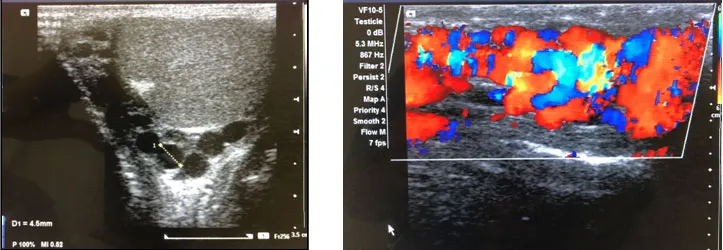
- Scrotal Doppler. A colour Doppler ultrasound shows the swollen veins and the blood flowing backwards. It is quick and uses no needles.
- Semen analysis, if fertility is a concern.
- Your options explained. Watching, embolisation or surgery, with what each involves. You decide with full information, and you are not pushed into a procedure.
Bring any previous ultrasound or semen reports. Medanta Vascular OPD is at Floor 5, Vascular OPD, Medicity, Islampur Colony, Sector 38, Gurugram, Haryana 122001. OPD hours are Monday to Saturday, 9:00 AM to 5:30 PM. See how to reach the Vascular OPD at Medanta and Dr. Virender Sheorain’s training and credentials.
Related pages: varicocele embolisation, varicocele surgery, prostate artery embolisation for an enlarged prostate, men’s health conditions.
Videos: varicocele

Common questions about varicocele
Can varicocele go away on its own?
A varicocele does not usually shrink away by itself, but many never cause problems and need no treatment. If there is no pain, no fertility concern and the testicle is a normal size, a doctor may simply check it from time to time. Treatment is usually considered when one of those changes.
Can tablets or homeopathy cure varicocele?
No. There is no reliable evidence that tablets, homeopathy or Ayurvedic medicines close the faulty vein. Painkillers and supportive underwear can ease the ache for a while. If the varicocele needs fixing, the options are embolisation or surgery.
Is varicocele embolisation painful?
It is usually done under local anaesthesia with light sedation, through a small needle puncture, so most patients feel pressure rather than sharp pain. Some men have a dull ache in the back or groin for a few days afterwards, which ordinary painkillers usually manage.
How long does recovery take after varicocele embolisation?
Most patients go home the same day or the next day and return to desk work within a few days. Heavy lifting and strenuous exercise are usually avoided for a short period, as advised by your doctor. Recovery advice is personalised at the follow-up visit.
Does varicocele affect fertility?
It can. A varicocele can raise the temperature around the testicle, which may affect sperm count and quality, but not every man with a varicocele has fertility problems. If you are trying for a child, a semen analysis helps decide whether treatment makes sense.
Sources
This page follows these patient resources and guidelines:
- Varicocele embolization: patient selection, preprocedure workup and technical considerations (Wadhwa et al., 2021) (Seminars in Interventional Radiology (NIH PMC))
- Varicocele fact sheet (revised 2023) (ReproductiveFacts, American Society for Reproductive Medicine)
- Varicocele (MedlinePlus Medical Encyclopedia)
- Varicocele embolization (RadiologyInfo, RSNA & ACR)
Related treatments
Varicocele Embolization
Blocks the enlarged vein through a small puncture, without surgery.
Learn more →Colour Doppler
A simple ultrasound, with no needles, that shows blood flow in veins and arteries.
Learn more →What is Embolization?
How blocking a blood vessel from inside treats many problems.
Learn more →
About the reviewing doctor
Dr. Virender Sheorain is Director, Peripheral Vascular & Endovascular Sciences, Medanta – The Medicity, Gurugram. He trained at AIIMS New Delhi and completed three fellowships in the USA.
Read Dr. Sheorain's profile →This is general information. Please consult the doctor for advice about your condition.