| What it treats | Varicose veins, chronic venous insufficiency, spider veins (sclerotherapy) |
|---|---|
| Anaesthesia | Local anaesthesia |
| Entry point | Needle puncture in the leg, guided by ultrasound |
| Time taken | Usually 30–60 minutes per leg |
| Hospital stay | Usually same day |
| Back to routine | Usually 1–3 days |
Endovenous treatment is a group of needle-based procedures for people with varicose veins, in which a doctor closes the leaking vein from the inside instead of removing it through cuts. “Endovenous” simply means “inside the vein”. UK national guidance (NICE CG168) recommends heat-based endovenous treatment, laser or RFA, as the first option to offer for most people whose varicose veins need treatment (NICE CG168). For the wider picture, including whether you need treatment at all, see all varicose vein treatment options.
Does laser treatment help varicose veins?
Yes, for veins that leak on a Doppler scan, laser treatment closes the faulty vein and usually eases aching, heaviness and swelling. It works on the main problem vein, often the long vein on the inner thigh (great saphenous vein) or the one at the back of the calf (small saphenous vein).
What it does:
- Closes the faulty vein so blood stops flowing backwards.
- Reroutes blood through healthy deep veins.
- Lets the closed vein slowly shrink and fade over time.
What it does not do:
- It does not remove tiny spider veins. These may need separate treatment, such as sclerotherapy.
- It does not stop new varicose veins forming in the future, because the tendency can remain.
- Some bulging branch veins may need foam or removal through tiny nicks (phlebectomy), either in the same sitting or at a later visit (ESVS 2022).
Which method suits you: laser, RFA or glue?
Laser, RFA and glue all close the vein from inside; they differ in how they seal it and how much numbing is needed. No method is right for everyone.
| Laser (EVLT) | RFA | Glue | Foam sclerotherapy | Surgery (for reference) | |
|---|---|---|---|---|---|
| How it closes the vein | Laser light energy heats the vein wall | Radiofrequency energy heats the vein wall | Medical adhesive seals the vein | Foam medicine irritates and seals the vein | Vein tied off and removed |
| Anaesthesia | Local, with numbing fluid around the vein (tumescent) | Local, with tumescent numbing | Local at the puncture; usually no tumescent numbing | Usually none | Spinal or general, usually |
| Cut | No, needle puncture | No, needle puncture | No, needle puncture | No, injection | Yes, small cuts |
| Walking afterwards | Same day | Same day | Same day | Same day | Slower |
| Stockings after | Often, for about a week | Often, for about a week | Often not needed | Often, for a short time | Usually |
| Who it usually suits | Straight main veins with reflux | Straight main veins with reflux | Suitable main veins; people who want fewer injections | Smaller, leftover or twisty veins | Some complex or recurrent veins |
Sources for the “how it works” and anaesthesia rows: NICE CG168; glue column: NICE IPG670; stockings row: NHS. Your own plan may differ.
Laser (EVLT). EVLT stands for endovenous laser treatment. A thin laser fibre is passed into the vein through a needle puncture. As it is slowly pulled back, it heats and closes the vein.
RFA. Radiofrequency ablation works in the same way as laser but uses radiofrequency energy delivered through a thin tube. Results are broadly similar to laser in studies (ESVS 2022).
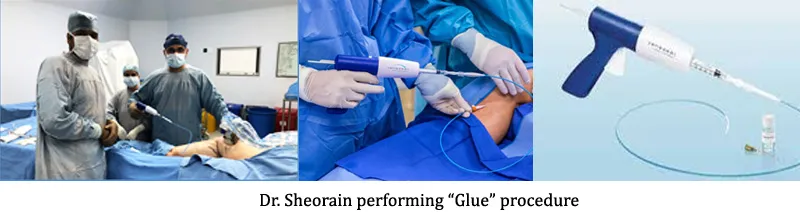
Glue. A small amount of medical adhesive is placed inside the vein to seal it. VenaSeal is one brand of glue system used for this. Because there is no heat, fewer numbing injections are usually needed. It is not right for people with certain allergies.
The choice depends on the size and path of the vein, how close it runs to the skin and nerves, and your own preference. After the Doppler scan, the doctor explains which method suits your leg.
How the procedure is done, step by step
Laser, RFA and glue procedures follow a similar path and are usually done as day care.
- Doppler mapping. The faulty vein is marked on your skin using a colour Doppler scan. Learn more about the colour Doppler scan.
- Numbing. Local anaesthesia numbs the skin. For laser and RFA, numbing fluid is also placed around the vein under ultrasound, which protects nearby tissue.
- Needle puncture. A small needle puncture is made, usually near the knee or ankle.
- Fibre, tube or glue catheter. A thin fibre or tube is passed up the vein under ultrasound.
- Closing the vein. Heat or glue closes the vein as the device is slowly withdrawn.
- Dressing and compression. A small dressing is placed. Stockings are fitted if advised.
- Walk out. You are encouraged to walk before going home.
The procedure usually takes under an hour for one leg. If both legs need treatment, they may be done on the same day or at separate visits, depending on how much needs treating.
Is laser better than surgery?
For most veins that need treatment, laser and other endovenous methods are now commonly preferred to open surgery, because they avoid cuts and usually allow a faster return to daily life (NICE CG168). Surgery still has a place for some veins. For the full comparison, see varicose vein surgery vs laser. Dr. Sheorain performs the needle-based treatments, not open surgery.
Who it is not right for
Endovenous treatment is not right for everyone, and Dr. Sheorain will tell you plainly if it is not a good choice for you.
It is usually not done, or is delayed, if you:
- have a current blood clot in a deep vein (DVT)
- are pregnant (treatment is usually put off until after the birth)
- have poor artery blood flow in the leg
- cannot walk about after the procedure
- are allergic to the glue (for glue treatment only)
Very twisted veins may suit foam or phlebectomy better than a fibre or catheter (ESVS 2022).
If a procedure is not suitable now, compression, treating another problem first, or another specialist may be the better route.
Recovery and aftercare
Most people walk the same day after laser, RFA or glue and return to light daily activity soon after.
- Walking regularly helps blood flow and lowers the clot risk.
- Stockings, if advised, usually for about a week (NHS).
- Bruising or tightness along the treated vein is common for a week or two.
- Return to work: most people can go back to desk work within a few days. Jobs with a lot of standing or heavy work may need longer. Avoid heavy exercise for a short time, as advised.
- Follow-up Doppler checks the vein has closed and there is no clot.
Risks and side effects
Endovenous treatments are generally well tolerated, but they do carry some risks (NICE CG168).
- Bruising and tenderness along the treated vein.
- Skin numbness or tingling, from nearby nerves being irritated, usually settling over time.
- Skin staining (brown marks) over the vein.
- Superficial phlebitis: a sore, firm, inflamed vein near the skin.
- Deep vein thrombosis (DVT): rare, but serious. Sudden swelling or pain in the leg, breathlessness or chest pain needs emergency care.
- Glue reaction: rare, a local skin reaction after glue treatment.
Results and success rate
In the studies reviewed by NICE and the European Society for Vascular Surgery, laser, RFA and glue closed the treated main vein in more than 9 out of 10 people (NICE IPG670, ESVS 2022). New varicose veins can still appear later in other veins, because the tendency to weak valves remains. These can usually be treated with a smaller procedure.
Even when the treated vein stays closed, new varicose veins can develop over the years. Regular follow-up helps catch this early.
Book a Doppler and consultation
Dr. Sheorain is an interventional radiologist, MD (Radiology), FSIR, trained at AIIMS New Delhi and in the USA, and has practised since 2007. At your first visit he examines your legs, reviews your Doppler and explains which method suits you, or whether you need treatment at all. Read more about Dr. Sheorain.
- Where: Vascular OPD at Medanta Gurugram, Floor 5, Medicity, Islampur Colony, Sector 38, Gurugram, Haryana 122001
- When: Monday to Saturday, 9:00 AM to 5:30 PM
Leg ulcers and skin changes are often caused by the same faulty veins; see chronic venous insufficiency. See other vein problems we treat.
Common questions about varicose vein treatment
Which is better, surgery or laser for varicose veins?
For most veins that need treatment, laser and other endovenous methods are now commonly preferred because they avoid an open cut and usually allow a faster return to normal life. Surgery still has a place for some veins. Your Doppler scan decides.
Is laser treatment for varicose veins painful?
It is usually done under local anaesthesia, so most people feel pressure or brief stinging during the numbing injections. A tight or bruised feeling along the treated vein for a week or two is common.
What is the difference between laser and RFA?
Both close the vein with heat from inside; laser uses light energy and RFA uses radiofrequency energy. Results are broadly similar in studies; the choice often depends on the vein and the doctor's experience.
What is VenaSeal (glue) treatment?
It closes the vein with a small amount of medical adhesive instead of heat, so fewer numbing injections are usually needed. It is not right for everyone, for example people with certain allergies.
Can varicose veins come back after laser?
The treated vein usually stays closed, but new varicose veins can develop over time because the tendency remains. Follow-up checks help catch this early.
Sources
This page follows these patient resources and guidelines:
- Cyanoacrylate glue occlusion for varicose veins (IPG670) (NICE interventional procedures guidance)
- ESVS 2022 Clinical Practice Guidelines on the Management of Chronic Venous Disease of the Lower Limbs (European Society for Vascular Surgery (Eur J Vasc Endovasc Surg 2022))
- Varicose veins: treatment (NHS)
- Varicose veins: diagnosis and management (CG168) (NICE guideline, UK)
- Varicose veins: evaluation and treatment (RadiologyInfo, RSNA & ACR)
- Varicose vein: noninvasive treatment (MedlinePlus Medical Encyclopedia)
Related
Varicose Veins
Swollen, twisted leg veins that ache or feel heavy.
Learn more →Chronic Venous Insufficiency
Long-term poor blood flow in leg veins, with swelling, skin changes and ulcers.
Learn more →Colour Doppler
A simple ultrasound, with no needles, that shows blood flow in veins and arteries.
Learn more →
Who performs this procedure
Dr. Virender Sheorain, Director, Peripheral Vascular & Endovascular Sciences, Medanta – The Medicity, Gurugram. Trained at AIIMS New Delhi and in three fellowships in the USA.
Read Dr. Sheorain's profile →This is general information. Please consult the doctor for advice about your condition.